
Wear Blue Wednesday — why drainage is the first line of flood defense
- community
- hydrology
- team
- culture
- flood-risk
In honor of Texas Flood Awareness Week, our team wears blue this Wednesday to show support for our shared commitment to flood risk awareness and stronger safety measures across the state.
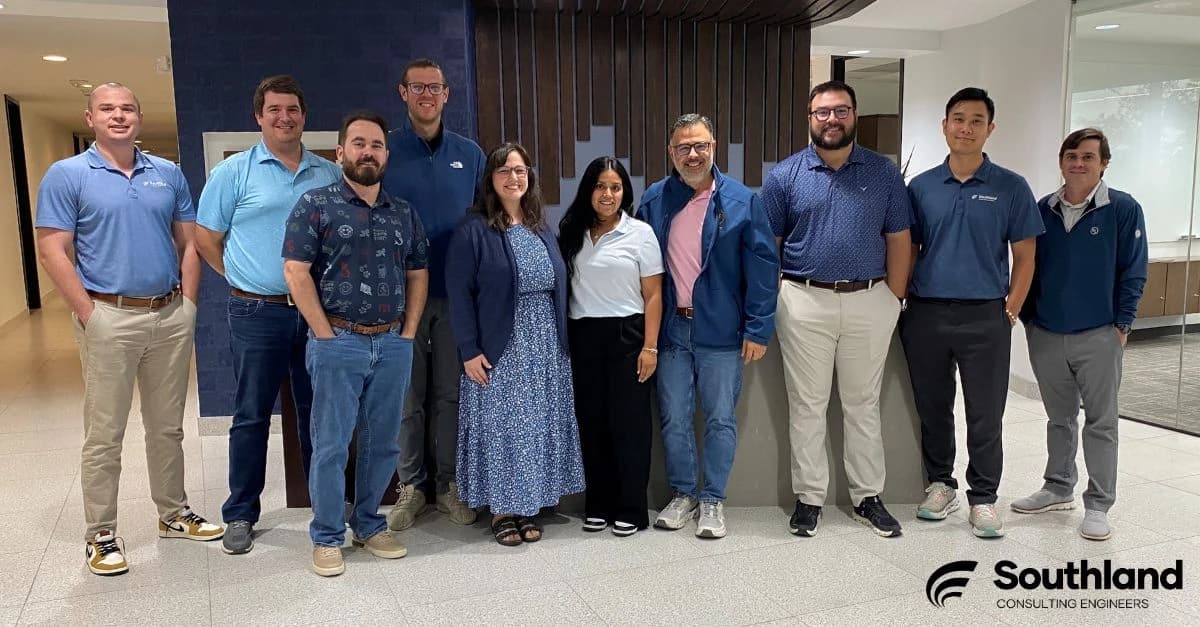
Where it rains, it can flood
The storms are only becoming more intense — as Texans witnessed firsthand with the devastating flooding in the Central Texas region nearly a year ago. It has never been more important to:
- Assess existing infrastructure capacity against current NOAA Atlas 14 rainfall data
- Ensure new developments are built with resilient drainage infrastructure from day one, not bolted on after the fact
The rainfall numbers we designed against ten years ago aren't the rainfall numbers we should be designing against today. NOAA Atlas 14 updates have meaningfully shifted the 100-year and 500-year design storms across Texas — and any project still using older precipitation data is, quietly, underdesigning for the floods that are already happening.
Civil engineering is the first line of defense
Civil engineers safeguard developed spaces from flood risk every day, even when nobody notices. We determine:
- Pad placements — where buildings sit relative to the surrounding floodplain and overland flow paths
- Finished floor elevations (FFEs) — how much freeboard a structure has above the design storm
- Storm sewer network capacity — pipe sizes, inlet placement, and routing through the site
- Detention basin design — volume, outlet structures, emergency overflow paths
- Overall site grading — how water moves through the project, what gets ponded, what gets conveyed downstream
Get those right and the flood risk for hundreds of future residents drops by orders of magnitude. Get them wrong and you've baked in a problem that's expensive — or impossible — to fix later.
How Southland does H&H
At Southland, our Hydrology & Hydraulics (H&H) team works alongside our land development teams from start to finish. Resilient drainage isn't a separate phase that happens after the site plan is locked — it's an input into the site plan from day one. That means:
- Detention is sized for the right storm using current Atlas 14 data, not legacy values
- Drainage decisions get coordinated with grading, lot yield, and utility routing so we don't have to compromise one to fix another
- Floodplain mitigation strategies maximize developable area without externalizing risk to neighbors
- Stormwater routing considers downstream impact, not just on-site compliance
Resilient drainage gets baked into every design rather than becoming a costly afterthought.
Texas communities, Texas storms
We're proud to serve our Texas communities by providing thoughtfully engineered drainage solutions that mitigate flood risk at every opportunity. Floods don't care about jurisdictional boundaries or pretty civil plans — they follow water, and water follows physics. Designing for that reality, from the very first feasibility memo, is part of how we earn the trust developers and municipalities place in us.
Stay safe out there, Texas. And if your project has H&H questions you want a second opinion on, reach out — we work in all corners of the state.
#TexasFloodAwarenessWeek · #WearBlueWednesday · #TFMA